English
 Deutsch
 中文简体
中文简体Content
- The Short Answer: What Is the Best Single Piece of Home Gym Equipment for Over 50s?
- Why Exercise Equipment Needs Change After 50
- Top Home Gym Equipment for Over 50s: Full Category Breakdown
- Head-to-Head Comparison: Best Home Gym Equipment for Over 50s
- How to Build a Complete Home Gym for Over 50s on Any Budget
- What to Avoid When Buying Home Gym Equipment After 50
- Key Features to Look for in Home Gym Equipment for Over 50s
- Exercise Principles That Make Home Gym Equipment More Effective After 50
- Frequently Asked Questions About Home Gym Equipment for Over 50s
The Short Answer: What Is the Best Single Piece of Home Gym Equipment for Over 50s?
If you can only buy one piece of home gym equipment after 50, a recumbent exercise bike is the single best choice for the majority of people in this age group. It delivers cardiovascular benefits comparable to upright cycling but with dramatically reduced stress on the knees, hips, and lower back. The reclined seat distributes body weight evenly, eliminating the spinal compression that comes from hunching over a standard bike. For someone managing arthritis, osteoporosis risk, or post-surgical recovery, this matters enormously.
That said, "best" is not a one-size-fits-all answer. The right gym equipment for over 50s depends on your health conditions, fitness goals, available space, and budget. This article breaks down the top contenders across multiple categories — cardio, strength, flexibility, and balance — so you can make a genuinely informed decision rather than buying something that collects dust within three months.
Why Exercise Equipment Needs Change After 50
The body at 50 or 60 is not simply an older version of a 30-year-old body — it operates under a fundamentally different set of physical rules. Understanding these changes is what separates effective home gym equipment for over 50s from equipment that causes injury or simply goes unused.
Muscle Mass Decline
From around age 30, humans lose roughly 3–8% of muscle mass per decade, a process called sarcopenia. After 60, that rate accelerates. This is not cosmetic — muscle loss directly correlates with increased fall risk, metabolic slowdown, and reduced functional independence. Resistance-based home gym equipment becomes non-negotiable for this reason alone.
Joint Sensitivity
Cartilage thins with age, synovial fluid decreases, and old injuries compound. According to the CDC, over 54 million adults in the United States have doctor-diagnosed arthritis, and the prevalence increases sharply after 45. This means high-impact equipment — think traditional treadmills used for running, or jump platforms — often does more harm than good for people over 50.
Bone Density
Postmenopausal women and older men both experience accelerated bone density loss. Weight-bearing and resistance exercise are among the most evidence-backed interventions for slowing this process, which is why strength-training home gym equipment should appear in almost every over-50s setup.
Balance and Fall Risk
Falls are the leading cause of injury-related death among adults aged 65 and older. Equipment that trains balance and proprioception — the body's sense of spatial positioning — directly addresses one of the most serious health risks of ageing. This is an aspect many over-50s gym equipment guides overlook entirely.
Top Home Gym Equipment for Over 50s: Full Category Breakdown
Below is a thorough evaluation of the most effective home gym equipment options for people over 50, organised by category. Each category addresses a different fitness priority, and a well-rounded home gym would ideally include at least one option from each.
Cardio Equipment
Recumbent Exercise Bike
As mentioned upfront, this is the top recommendation. The recumbent bike allows you to work at moderate-to-high cardiovascular intensity while sitting in a reclined position with back support. Knee flexion is limited compared to upright bikes, and there is zero impact on the joints. Studies published in journals like the Journal of Aging and Physical Activity consistently show that recumbent cycling improves VO2 max, reduces blood pressure, and supports weight management in older adults with minimal adverse events.
Models to consider typically range from £300–£900 / $350–$1,100 for quality options. Look for a step-through frame design for easy mounting and dismounting, a large backlit display, multiple resistance levels, and a comfortable padded seat with lumbar support.
Elliptical Trainer
An elliptical mimics running without any of the ground impact — the feet never leave the pedals. Research from the American Council on Exercise found that elliptical training produces caloric burn comparable to treadmill running at the same perceived exertion level, but with significantly lower joint loading. Models with handles also engage the upper body, turning a cardio session into a near-full-body workout. For home gym use after 50, a front-drive elliptical tends to offer a more natural stride length and is usually more compact than rear-drive models.
Walking Treadmill (Low Speed / Under-Desk)
Not every treadmill is designed for running. Flat, low-speed walking treadmills — including under-desk models — have surged in popularity because they allow older adults to accumulate the recommended 150 minutes of moderate-intensity activity per week (per WHO guidelines) in manageable, low-impact increments throughout the day. If running feels uncomfortable on the joints, a walking-specific treadmill used at 3–4 km/h is far more sustainable than a full-size treadmill used poorly.
Strength Training Equipment
Adjustable Dumbbells
Adjustable dumbbells are arguably the highest value-per-square-foot piece of gym equipment for over 50s. A single pair of adjustable dumbbells — such as the Bowflex SelectTech 552 or the PowerBlock Elite — replaces an entire rack of fixed-weight dumbbells and takes up minimal floor space. They allow progressive overload (gradually increasing resistance over time), which is essential for muscle maintenance and bone density preservation. A full set covering 2 kg to 24 kg (5 lb to 52.5 lb) provides enough range for virtually every exercise an over-50s programme requires, from light rehabilitation work to moderately heavy strength training.
Resistance Bands with Door Anchors
Often underestimated, resistance bands offer joint-friendly strength training that is particularly well-suited to people recovering from injury or with limited grip strength. Unlike free weights, bands provide accommodating resistance — the tension increases as the band stretches, matching the natural strength curve of many exercises. A complete set of bands with varying resistance levels and a door anchor costs as little as £25–£50 and can replicate cable machine exercises that would otherwise require an expensive piece of gym equipment.
Cable Machine / Functional Trainer
For those with more space and a larger budget, a compact cable machine is one of the most versatile pieces of strength gym equipment for home use after 50. Cable machines allow training across multiple angles and planes of motion, which is more functional than most fixed-weight machines. They are particularly good for rotational movements and exercises that mimic daily activities — pulling, pushing, and lifting from different heights. Home-friendly dual-cable machines are available from around £500–£2,000 depending on weight stack size and build quality.
Kettlebells
A single kettlebell can facilitate a surprisingly complete workout. Movements like the kettlebell swing, goblet squat, and single-arm press develop strength, power, and coordination simultaneously. For over 50s, starting with a 8 kg or 12 kg kettlebell and working under guidance (a qualified coach or a reputable online programme) produces excellent results. Two or three kettlebells of different weights form the basis of a solid minimalist home gym.
Balance and Stability Equipment
Balance Board
A wobble board or rocker balance board challenges the small stabilising muscles of the ankles, knees, and hips that are frequently neglected in standard workout routines. Just five to ten minutes of daily balance board work has been shown in multiple studies to reduce fall incidence in older adults by up to 37%. These cost as little as £20–£40 and take up virtually no storage space.
Stability Ball
An anti-burst exercise ball is used not just for core work but also as an unstable surface that forces the body to recruit stabilising muscles during any exercise performed on or against it. Seated dumbbell presses on a stability ball, for example, activate the core and spinal stabilisers far more than the same movement on a flat bench. A quality stability ball costs under £25 and is one of the best pound-for-pound investments in a home gym for the over-50s.
Flexibility and Mobility Equipment
Foam Roller
Myofascial release using a foam roller has gone from a niche physiotherapy tool to mainstream gym equipment for good reason. Regular use reduces muscle soreness, improves tissue quality, and helps maintain the range of motion that tends to decline with age. For over 50s, this is particularly relevant in the thoracic spine, hips, and calves — areas that tighten considerably with age and reduced activity. A high-density roller costs between £15–£40.
Yoga Mat
A thick, non-slip yoga mat (at least 6 mm) is essential for floor-based stretching, mobility work, and any low-impact exercise. It provides cushioning for knees and wrists, and a defined space that psychologically reinforces the habit of daily movement. For anyone combining their home gym setup with yoga, Pilates, or physiotherapy exercises, a quality mat is foundational.
Head-to-Head Comparison: Best Home Gym Equipment for Over 50s
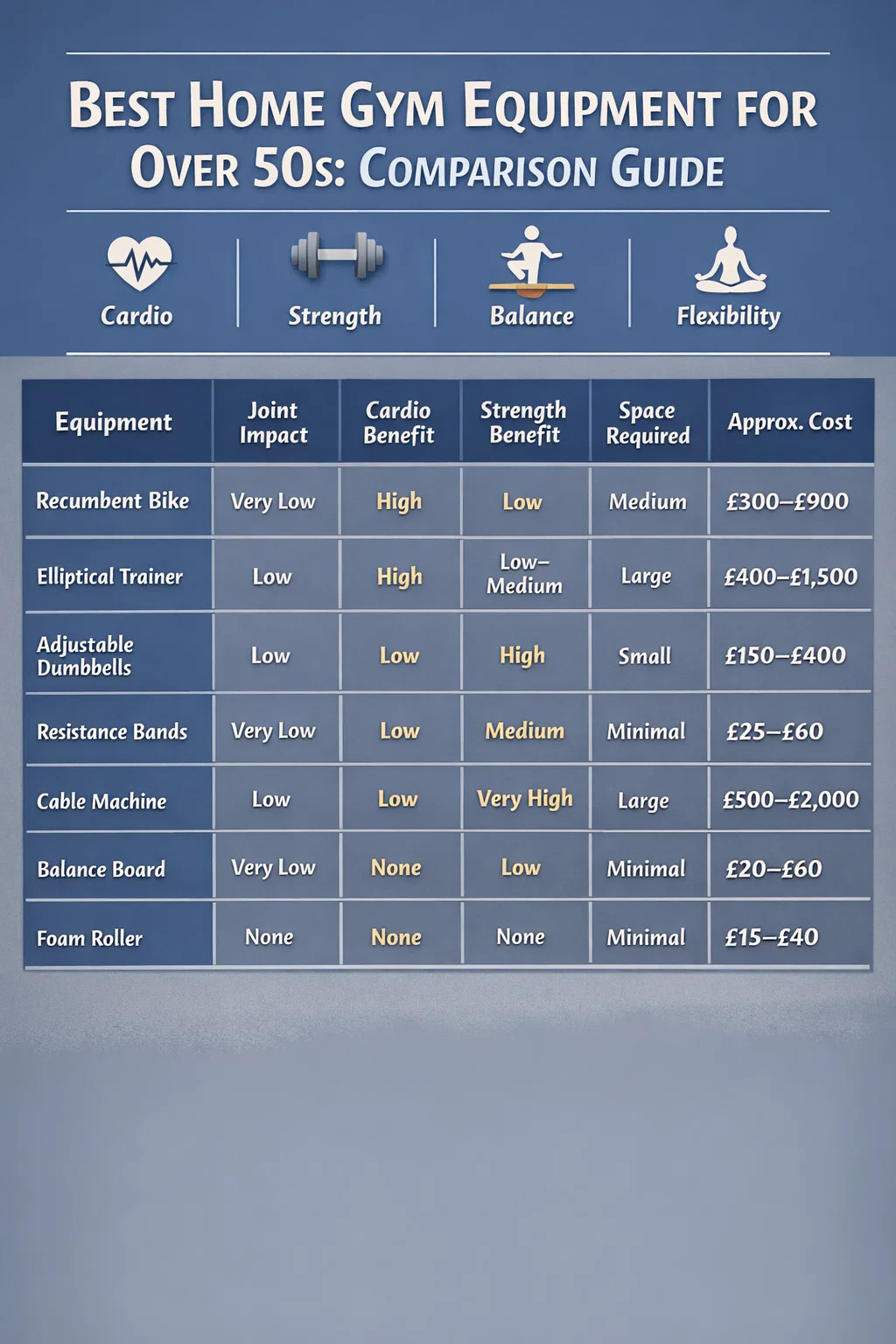
The table below compares the most popular gym equipment options across key criteria relevant to over-50s buyers.
| Equipment | Joint Impact | Cardio Benefit | Strength Benefit | Space Required | Approx. Cost |
|---|---|---|---|---|---|
| Recumbent Bike | Very Low | High | Low | Medium | £300–£900 |
| Elliptical Trainer | Low | High | Low–Medium | Large | £400–£1,500 |
| Adjustable Dumbbells | Low | Low | High | Small | £150–£400 |
| Resistance Bands | Very Low | Low | Medium | Minimal | £25–£60 |
| Cable Machine | Low | Low | Very High | Large | £500–£2,000 |
| Balance Board | Very Low | None | Low | Minimal | £20–£60 |
| Foam Roller | None | None | None | Minimal | £15–£40 |
How to Build a Complete Home Gym for Over 50s on Any Budget
You do not need to spend thousands to build a functional, effective home gym for over 50s. Here is how to prioritise across three budget levels.
Budget Setup: Under £200
- Resistance band set with door anchor (£30)
- A pair of fixed-weight dumbbells or a light kettlebell (£40–£60)
- Balance board (£30)
- Foam roller (£20)
- Yoga mat (£20)
This setup covers strength, mobility, flexibility, and balance. Cardio can be handled by brisk walking outdoors or a basic jump rope if joint health allows.
Mid-Range Setup: £500–£1,000
- Recumbent exercise bike (£400–£600)
- Adjustable dumbbell set (£150–£250)
- Foam roller and yoga mat (£40)
- Balance board (£30)
This is the most well-rounded setup for over 50s and covers all four pillars — cardio, strength, balance, and flexibility — without requiring a dedicated room or complex installation.
Premium Setup: £2,000+
- High-end recumbent bike or elliptical with interactive display (£800–£1,500)
- Compact dual cable machine (£800–£1,500)
- Adjustable dumbbells (£200–£350)
- Stability ball, foam roller, balance board, yoga mat (£100)
A premium home gym for over 50s rivals a commercial gym in functional terms. The cable machine in particular adds an enormous range of exercise options and is the closest thing to a personal trainer's arsenal in a single piece of equipment.
What to Avoid When Buying Home Gym Equipment After 50
Knowing what not to buy is just as important as knowing what to buy. These are the most common mistakes people make when setting up a home gym in their 50s or 60s.
- High-impact treadmills used for running: The joint forces generated by running on a treadmill are not meaningfully reduced compared to outdoor running. If you experience knee or hip pain during running, switching to a treadmill does not solve the underlying problem. A recumbent bike or elliptical is a better investment.
- Heavy barbell sets without safety equipment: Barbell training is not inherently inappropriate for over 50s, but setting up a barbell rack without safety catches or a spotter is a meaningful fall and crush hazard. If you want to train with barbells at home, invest in a quality power rack with adjustable safety bars.
- Gadget-heavy novelty equipment: Vibration plates, ab rollers with extreme resistance, and similar gimmick-adjacent products are frequently marketed at the 50+ demographic but lack meaningful evidence to support their claims. Stick to proven categories: cardio machines, free weights, resistance bands, and mobility tools.
- Fixed-weight machines that lock you into one movement plane: Chest press machines, leg extension machines, and similar seated fixed-path equipment are common in commercial gyms but are suboptimal for home use. They train muscles in isolated, non-functional patterns, take up substantial space, and cannot be adjusted as your fitness evolves.
- Cheap, poorly reviewed equipment with no weight limits clearly stated: Many budget gym equipment pieces sold online have weight capacity limits of 100–110 kg. This matters not just for safety but for stability — equipment that flexes or wobbles at the user's body weight is both dangerous and discouraging to use.
Key Features to Look for in Home Gym Equipment for Over 50s
Regardless of which specific piece of equipment you choose, these features consistently separate good options from disappointing ones for older adults.
- Step-through or low-barrier entry: Getting on and off cardio equipment should not itself be a balance challenge. Step-through frames on recumbent bikes and low step-up heights on ellipticals make daily use safer and more accessible.
- Adjustability: Seat positions, handlebar heights, pedal strap widths, and resistance increments should all be adjustable. A machine that fits only one body type will quickly become uncomfortable to use.
- Heart rate monitoring: Training in the correct heart rate zone is particularly important for over 50s who may be managing cardiovascular conditions. Built-in pulse grips or Bluetooth compatibility with chest straps make this easy.
- Quiet operation: Magnetic resistance systems (found in better exercise bikes and ellipticals) operate almost silently, making early morning or late evening sessions possible without disturbing others.
- Stable, non-slip base: Any equipment that involves standing or dynamic movement should have rubberised feet and a wide, stable base. This is basic but often skimped on in cheaper models.
- Warranty and customer support: Quality home gym equipment brands typically offer at least 2 years on parts and 1 year on labour. Brands that offer 5-year or lifetime frame warranties are generally making a genuine quality statement rather than a marketing one.
Exercise Principles That Make Home Gym Equipment More Effective After 50
The best gym equipment in the world will not produce results if the training approach is wrong. These principles are specifically relevant to adults over 50.
Prioritise Recovery
Recovery time between sessions increases with age. Where a 25-year-old might train the same muscle group every 48 hours, over 50s often need 72 hours or more between high-intensity sessions. This is not a weakness — it is physiology. Training three to four days per week with deliberate rest days produces better long-term results than daily sessions that outpace recovery.
Warm Up Properly
A proper warm-up at 50 is not optional. At minimum, spend 10 minutes on light cardiovascular movement (even a slow cycle on your recumbent bike) followed by dynamic stretching of the major muscle groups you will be training. Cold muscles and connective tissue are substantially more injury-prone, and injuries that would have been minor at 30 can require months of recovery at 60.
Train Consistently Over Intensely
The research is consistent: frequency and consistency trump intensity for long-term outcomes in older adults. Three moderate sessions per week sustained over a year will produce far greater health benefits — and far fewer injuries — than sporadic high-intensity sessions. Home gym equipment makes consistency easier because there is no commute, no membership fee anxiety, and no waiting for machines.
Incorporate All Four Pillars
The World Health Organization and most leading exercise medicine bodies recommend that adults over 65 (and ideally from 50 onwards) engage in all four types of physical activity: aerobic, strength, balance, and flexibility. A home gym setup that covers all four — even modestly — delivers substantially better health outcomes than one that focuses exclusively on cardio or exclusively on weights.
Frequently Asked Questions About Home Gym Equipment for Over 50s
Is it safe to lift weights at 50, 60, or 70?
Yes — and in fact, resistance training becomes more important with age, not less. The key is appropriate load, controlled technique, and adequate recovery. Numerous studies, including long-term trials published in the British Journal of Sports Medicine, have confirmed that progressive resistance training is safe and beneficial for healthy older adults and even for those managing chronic conditions like osteoporosis or type 2 diabetes, when done with appropriate medical clearance.
How much space do I need for a home gym at 50+?
A functional home gym for over 50s can fit in a 3 x 3 metre space if you choose compact, multi-purpose equipment. A recumbent bike, a pair of adjustable dumbbells, a yoga mat, and a foam roller take up very little room and can be arranged in a spare bedroom corner or a garage section. Larger equipment like ellipticals and cable machines need more space — typically at least 2 x 3 metres per machine.
Should I see a doctor before starting a home gym programme at 50+?
If you have been sedentary for several years, have known cardiovascular conditions, or are managing any chronic health condition, a pre-exercise medical check is advisable. Most GPs support exercise strongly but can flag specific limitations — for example, certain heart conditions require avoiding breath-holding during exertion (the Valsalva manoeuvre common in heavy lifting). A physiotherapist assessment is also valuable if you have existing joint or musculoskeletal issues.
What is better for over 50s — cardio or strength training?
Both are essential, and the research does not support prioritising one over the other. Cardiovascular exercise protects heart health, manages weight, and improves mood. Strength training preserves muscle mass, supports bone density, and maintains functional independence. The most evidence-backed approach is to do both — most guidelines recommend at least 150 minutes of moderate aerobic activity and two strength sessions per week for adults over 50.