English
 Deutsch
 中文简体
中文简体Content
- The Direct Answer: Best-Selling Fitness Equipment Categories in 2026
- Treadmills: Still the Best-Selling Large Fitness Equipment in 2026
- Resistance Bands: The Highest Unit-Volume Fitness Equipment on the Planet
- Adjustable Dumbbells: The 2026 Home Gym Centerpiece
- Stationary Bikes: Connected Fitness's Most Competitive Product Category
- Smart Home Gym Systems: The Fastest-Growing Premium Fitness Equipment Segment
- Rowing Machines and Ellipticals: Strong Mid-Tier Performers With Loyal Audiences
- Yoga Mats, Recovery Gear, and Small Accessories: High-Volume Sales Hiding in Plain Sight
- The 2026 Fitness Equipment Market at a Glance: Sales by Price Tier
- Key 2026 Fitness Equipment Trends Shaping What Sells
- AI Coaching Is Moving from Premium Feature to Standard Expectation
- Connected Fitness Equipment Is the Second-Fastest Growing Product Segment
- Space Efficiency Is a Primary Purchase Driver in 2026
- Strength Training Equipment Is Outgrowing Cardio
- Asia-Pacific Is the Fastest-Growing Regional Market
- Recovery Equipment Is a Rapidly Expanding Sales Category
- VR and Gamified Fitness Equipment Is Moving From Fringe to Mainstream
- Commercial Fitness Equipment: What Gyms and Facilities Are Buying in 2026
- How to Choose the Right Fitness Equipment in 2026
The Direct Answer: Best-Selling Fitness Equipment Categories in 2026
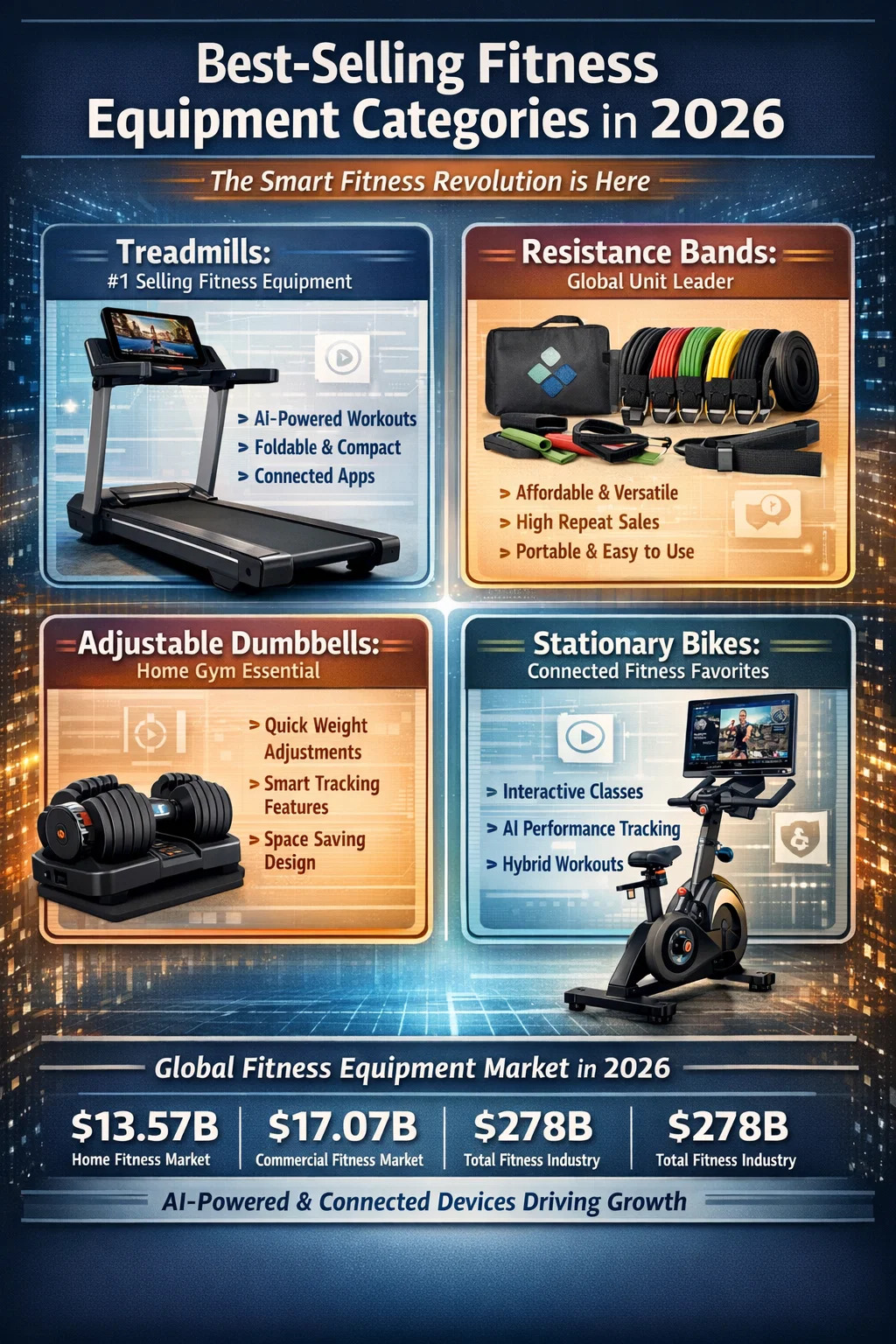
If you want the bottom line up front: treadmills, resistance bands, adjustable dumbbells, and stationary bikes remain the top-selling fitness equipment globally in 2026—but smart, AI-connected versions of these products are now rapidly overtaking their traditional counterparts in the mid-to-premium price tiers. The market has shifted, and the products winning on shelves today are the ones that combine hardware with digital ecosystems.
The numbers back this up. According to Fortune Business Insights, the global home fitness equipment market is projected to reach $13.57 billion in 2026, growing at a CAGR of 6.81% through 2034. The broader fitness equipment industry—including commercial gym equipment—is assessed at $17.07 billion in 2025 and forecast to reach $39.69 billion by 2037, registering a CAGR of over 7.1%. The global fitness industry overall is projected to be worth $278 billion in 2026, growing at 7.9% annually.
Whether you are a consumer building a home gym, a retailer deciding what to stock, or a brand strategist planning the next product launch, understanding which fitness equipment sells best in 2026—and why—gives you a concrete edge in a crowded market.
Treadmills: Still the Best-Selling Large Fitness Equipment in 2026
Treadmills have held the top position in large cardio fitness equipment sales for decades, and 2026 is no different—except the product itself has changed considerably. The best-selling treadmill models are no longer simple motorized belts. In January 2026, Fitkol launched its NB Series treadmills featuring the proprietary SportMind™ intelligent training system, which uses AI to dynamically adjust workouts in real time based on physiological feedback. UREVO's compact treadmill lineup, debuted at CES 2025 and continuing strong in 2026, emphasizes space-efficient design, digital connectivity, and app-based training targeted at urban consumers.
The cardiovascular equipment segment—led by treadmills—maintains over 53% revenue dominance within the total fitness equipment market, according to Persistence Market Research. At the same time, strength training equipment is the fastest-growing category at a 6.5% CAGR, suggesting that while cardio still commands the largest revenue share, the gap is beginning to close as home gym culture matures.
What's Driving Treadmill Sales in 2026
- Foldable and compact designs are a leading 2026 trend, with models like the WalkingPad under-desk series and NordicTrack foldable lineup selling strongly to urban, space-constrained buyers working from home.
- Interactive screen integration has become a baseline expectation in the $800+ tier, with global course simulations and trainer-led virtual sessions making cardio more engaging.
- AI-adaptive training systems that adjust speed and incline based on real-time biometric data are the defining differentiator between premium treadmills and budget models in 2026.
- Price range breadth: Budget models under $500 still move the highest unit volumes, while premium connected treadmills at $2,000–$4,000 generate the highest revenue per unit. NordicTrack treadmills carry an example price of $2,699 in 2026 according to WodGuru's gym equipment brand analysis.
North America dominates the home fitness equipment market with a 37.46% market share in 2025, with the U.S. market alone projected to reach $4.32 billion by 2026. Treadmills are a central driver of that figure.
Resistance Bands: The Highest Unit-Volume Fitness Equipment on the Planet
Measured by units sold rather than revenue, resistance bands remain the single best-selling fitness product in the world in 2026. At price points between $10 and $30 for a full set, they are impulse purchases that cross every demographic and fitness level. On Amazon, resistance band sets from brands like Fit Simplify and THERABAND consistently hold "Best Seller" badges in the exercise and fitness category, with individual SKUs accumulating tens of thousands of reviews.
The dropshipping fitness products industry lists resistance bands as a must-stock item for 2026, citing their high demand, low shipping costs, and universal appeal across physical therapy, strength training, stretching, and warm-up applications. These are also the products that generate the most repeat purchase behavior in the fitness equipment category—bands wear out, snap, or get lost, creating consistent reorder cycles.
Why Resistance Bands Continue to Lead on Unit Sales
- Accessibility: No assembly, no installation, no setup friction. They work in any room, outdoors, or in a hotel.
- Versatility: A single set can replace dozens of individual exercises across strength, mobility, and rehabilitation.
- Gifting appeal: Low price makes them a year-round gifting product with significant spikes in Q4 and early January.
- Search volume: "Resistance bands" remains one of the highest-searched fitness equipment terms globally, making organic discoverability strong for online retailers.
Adjustable Dumbbells: The 2026 Home Gym Centerpiece
Adjustable dumbbells have graduated from a niche convenience product to a home gym essential in 2026. Men's Journal's 2026 Fitness Awards named the Bowflex Results Series 1090 SelectTech Dumbbells as the best home gym equipment for heavy lifters, while Speediance Gym Monster 2 took the overall best home gym equipment award. Adjustable dumbbell sets now routinely top "best fitness equipment" roundups across major publications tested in the field—not just on spec sheets.
Smart versions are entering the market in 2026. Connected adjustable dumbbells track reps, sync with apps, and provide real-time feedback through paired mobile applications. Tempo Studio's system—which uses AI computer vision to analyze free weight form and auto-adjust programming—is a leading example of where premium adjustable dumbbell systems are heading. According to WodGuru's 2026 gym equipment brand analysis, Bowflex SelectTech adjustable dumbbells are priced at $299–$700 depending on configuration, making them accessible to a wide range of home gym buyers.
Dumbbell Market Breakdown by Type in 2026
| Type | 2026 Price Range | Best For | Top Sales Channel |
|---|---|---|---|
| Fixed Hex Dumbbells | $1–$2.50/lb | General strength, rack builds | Amazon, Walmart |
| Adjustable Dumbbells (Standard) | $200–$700/set | Space-efficient home gyms | Amazon, brand direct |
| Smart Adjustable Dumbbells | $400–$900/set | Tech-focused users, app-guided training | Brand websites, specialty retailers |
| Neoprene Light Dumbbells | $10–$50/pair | Beginners, cardio workouts, seniors | Target, Amazon, Walmart |
The adjustable kettlebell is also gaining ground in 2026. The Lifepro PowerStone Boulder—which adjusts from 5 to 44 lbs—earned recognition in Men's Journal's 2026 awards as best home gym equipment for small spaces, reflecting the broader trend toward multi-weight tools that eliminate the need for racks of separate units.
Stationary Bikes: Connected Fitness's Most Competitive Product Category
Exercise bikes have become one of the most popular fitness equipment categories in 2026, according to OutdoorGearLab's January 2026 equipment review update. The category has evolved beyond Peloton's early dominance into a highly competitive multi-brand landscape where connected features are a baseline expectation rather than a premium differentiator.
Peloton remains relevant but is no longer the only name in the room. The company reported $408.3 million in connected fitness revenue in Q4 2025, according to its shareholder letter, signaling sustained demand even as its subscriber growth has stabilized. Echelon's AI-personalized platform—which analyzes heart rate, workout history, and preferences—has driven a 7% increase in user retention rates, a metric that illustrates how data-driven personalization directly translates to business outcomes. iFIT has expanded globally by using AI to localize its Emmy-nominated training content into multiple languages.
Indoor Cycling vs. Recumbent Bikes in 2026
- Indoor/spin bikes with app connectivity and virtual class libraries dominate the $800–$2,500 segment. Brands like Schwinn, Echelon, and NordicTrack offer Peloton-comparable features at significantly lower price points—the Schwinn IC4 at around $799 remains a consistent top seller in this bracket.
- Recumbent bikes serve a large and underserved demographic: older adults, rehabilitation patients, and people with joint pain. The HARISON recumbent bike with its step-through frame and low-impact design is highlighted as a leading 2026 pick for seniors and accessible cardio, reflecting a maturing market that no longer exclusively targets young athletic users.
- Under-desk bike pedal exercisers are a fast-growing 2026 niche, directly tied to the remote work trend. These small, inexpensive units allow movement during the workday without requiring dedicated workout time.
WodGuru's 2026 brand price guide lists NordicTrack exercise bikes at $899 and Schwinn bikes at $799 as representative models in the mid-market tier—both in the sweet spot that generates the highest unit sales volume in connected fitness.
Smart Home Gym Systems: The Fastest-Growing Premium Fitness Equipment Segment
The smart home gym equipment market is one of the most important growth stories in fitness equipment sales in 2026. According to a January 2026 report published on GlobeNewswire, the global smart home gym equipment market is projected to expand from $3.01 billion in 2025 to $3.80 billion by 2031, registering a CAGR of 3.97%. The broader smart fitness market—which includes wearables and apps—is valued at $18.8 billion in 2026 and forecast to reach $60.4 billion by 2036 at a 12.4% CAGR, according to Future Market Insights.
The American College of Sports Medicine's November 2025 Worldwide Survey of Fitness Trends for 2026 identified Wearable Technology as the single leading global fitness trend—a clear signal that the intersection of hardware and digital data is where consumer attention and spending is concentrating. The Consumer Technology Association reported in 2025 that more than 65% of U.S. consumers now use at least one form of connected fitness technology.
Top-Rated Smart Home Gym Equipment in 2026
- Tonal 2 Smart Home Gym: Rated the best smart home gym overall by Garage Gym Reviews in 2026. Wall-mounted, requires only 7 square feet, delivers 250 lbs of digital electromagnetic resistance, and uses AI to automatically increase load based on user readiness. Ideal for apartment dwellers and users without dedicated gym space.
- Speediance Gym Monster 2: Named best home gym equipment overall in Men's Journal's 2026 Fitness Awards. Described as the most versatile single machine tested, with quick exercise switching, Bluetooth Ring integration, and app-guided programming.
- Major Fitness Heritage Series B17 Flying Fortress: Named best all-in-one home gym by Garage Gym Reviews in February 2026. Combines a functional trainer with a Smith machine and a full cable system—appealing to serious lifters who want commercial-gym capability at home. The company's B52 Pro model is noted to be increasing in price by $200 in April 2026, signaling rising demand and margin expansion.
- MaxPro Smart Connect: Best home gym equipment for workouts on the road (Men's Journal 2026). Delivers up to 300 lbs of adjustable cable resistance in a package that fits in a backpack—an outlier product that captures frequent travelers and those who want no fixed infrastructure.
- Tempo Studio: AI-powered free weight system with computer vision that detects plate colors and tracks form in real time. Best suited for users who prefer barbell and dumbbell training but want the coaching layer of a smart gym.
The connected gym equipment market specifically—hardware that integrates internet connectivity, AI, and interactive software—was valued at $1.2 billion in 2024 and is projected to reach $3.5 billion by 2033 at a 14.5% CAGR, according to a January 2026 PRNewswire market report. This trajectory is more than double the growth rate of the traditional gym equipment segment.
Rowing Machines and Ellipticals: Strong Mid-Tier Performers With Loyal Audiences
Rowing machines continue to hold a strong position in home gym sales in 2026, buoyed by the fitness community's enduring appreciation for rowing as a full-body, low-impact, high-output exercise. The Ergatta Luxe Rower was named best home gym equipment for at-home cardio in Men's Journal's 2026 Fitness Awards—a connected rowing machine that uses game-based competitive content to keep users engaged, drawing parallels to Peloton's strategy in the bike category.
Elliptical trainers occupy a valuable niche for buyers seeking low-impact cardio that is gentler on joints than running. The NordicTrack elliptical is listed at $1,799 in 2026 pricing guides, while Schwinn ellipticals come in at $999—both maintaining strong mid-market positions. The elliptical category appeals particularly to users over 45 and to individuals managing knee or hip conditions, a demographic that is growing as the population ages.
According to Persistence Market Research, cardiovascular equipment as a whole maintains a 4.2% CAGR through the forecast period—solid but increasingly outpaced by strength training equipment at 6.5% CAGR, which reflects the cultural shift toward resistance training and functional fitness.
Yoga Mats, Recovery Gear, and Small Accessories: High-Volume Sales Hiding in Plain Sight
Small fitness equipment accessories—yoga mats, foam rollers, jump ropes, ab wheels, and weighted vests—collectively represent massive unit sales volumes that often go underreported in market analyses focused on large machines. On Amazon's current best-seller listings in the fitness category, jump rope sets, ZELUS weighted vests (6–30 lbs with reflective stripes), and vibration plates appear alongside traditional cardio equipment, all ranked among the most purchased fitness products.
Recovery equipment is a standout growth category in 2026. Hyperice's recovery gear line—including the X2 Knee and Shoulder portable contrast therapy device combining cold (down to 40°F), heat (up to 121°F), and compression—represents the premium end of a category that gyms and home users are investing in more heavily than ever. Recovery equipment, once an afterthought, is now a primary purchase for consistent exercisers who understand that adaptation happens during rest, not just during the workout itself.
Suspension Trainers: Proven Sellers With a Dedicated Community
Suspension trainers like TRX remain strong sellers in 2026. Priced around $150–$200, they offer a complete bodyweight training solution that attaches to any door frame, beam, or anchor point. The dropshipping fitness industry specifically calls out suspension trainers as "a premium product with a dedicated audience" for 2026—used by personal trainers, military programs, and elite athletes, making them credible to serious buyers. TRX's training ecosystem, including certification programs and app content, sustains its sales through community loyalty rather than pure price competitiveness.
The 2026 Fitness Equipment Market at a Glance: Sales by Price Tier
Sales patterns in 2026 vary considerably by price point, with smart connectivity features increasingly becoming the dividing line between budget and premium categories.
| Price Tier | Top-Selling Equipment | 2026 Example Products | Primary Channel |
|---|---|---|---|
| Under $30 | Resistance bands, jump ropes, yoga mats | Fit Simplify bands, Gaiam mat, AXV vibration board | Amazon, Walmart |
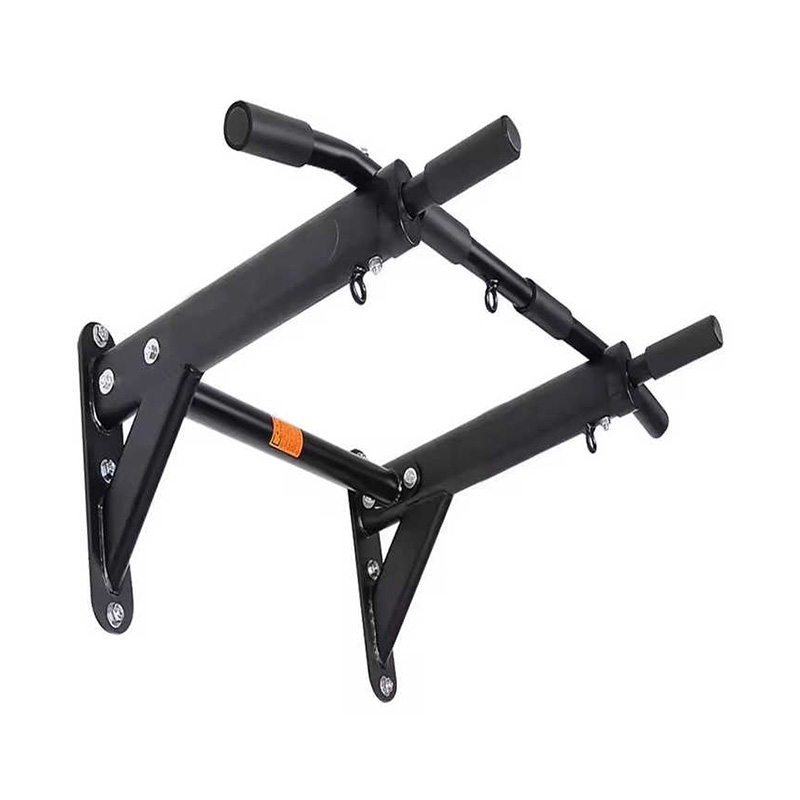
| $30–$150 | Pull-up bars, ab wheels, foam rollers, weighted vests | Iron Gym bar, ZELUS weighted vest, TriggerPoint roller | Amazon, Target |
| $150–$500 | TRX trainers, adjustable dumbbells, Pilates bars | TRX system, Bowflex SelectTech 552, Lifepro PowerStone | Amazon, brand direct |
| $500–$1,500 | Connected bikes, treadmills, rowing machines | Schwinn IC4, Ergatta Luxe Rower, Horizon treadmill | Brand sites, Amazon, Dick's |
| $1,500–$4,000 | Smart treadmills, all-in-one gyms, cable systems | Tonal 2, NordicTrack 1750, Speediance Gym Monster 2 | Brand direct, specialty retailers |
| $4,000+ | Commercial-grade multi-station systems, Technogym | Technogym treadmills ($9,999), Major Fitness B17 | Commercial dealers, brand direct |
Key 2026 Fitness Equipment Trends Shaping What Sells
Several structural shifts are actively determining which fitness equipment wins on shelves in 2026. These are not speculation—they are already reflected in the sales data and product development pipelines of major brands.
AI Coaching Is Moving from Premium Feature to Standard Expectation
In 2026, AI is no longer a selling point reserved for $3,000 machines. Tonal 2 automatically adjusts resistance based on when the AI determines a user is ready to progress. Peloton has debuted a new AI and computer vision system that guides users across all its equipment lines. The Shred App offers AI-powered personal training for $9.99 per month, making intelligent coaching accessible at a price point previously unimaginable. Fitness brands that are not integrating AI into their product ecosystems are already losing ground to those that are.
Connected Fitness Equipment Is the Second-Fastest Growing Product Segment
Connected fitness equipment is growing at 32% annually and is forecast to reach $3.7 billion by 2028, according to Wellness Creatives' 2026 fitness industry report. This is the second-fastest growing product segment in the entire equipment market. The connected gym equipment market specifically hit $1.2 billion in 2024 and is on track for $3.5 billion by 2033 at a 14.5% CAGR. These numbers reflect a structural shift in what buyers expect from fitness equipment, not a temporary premium trend.
Space Efficiency Is a Primary Purchase Driver in 2026
Three major trends identified in 2026 fitness equipment market analysis are: integrated smart ecosystems, space-optimized designs, and commercial-grade construction entering home equipment. Foldable treadmills, wall-mounted smart gyms like Tonal, compact all-in-one cable systems, and adjustable multi-weight tools are all outperforming their fixed-footprint equivalents in urban markets. Remote work has permanently changed where people exercise, and equipment manufacturers that solve for small apartments are capturing disproportionate market share.
Strength Training Equipment Is Outgrowing Cardio
Strength training equipment is the fastest-growing category in fitness equipment at a 6.5% CAGR, driven by functional fitness adoption, the popularization of resistance training for longevity and metabolic health, and home gym culture shifting away from cardio-first approaches. While cardiovascular equipment still commands the largest revenue share at 53%+, that dominance is moderating as buyers prioritize racks, cable machines, dumbbells, and kettlebells. Nike's 2023 expansion into branded barbells, dumbbells, and kettlebells is a clear indicator of where the commercial opportunity is heading.
Asia-Pacific Is the Fastest-Growing Regional Market
While North America dominates in absolute market size, Asia-Pacific is the fastest-growing region at a 6.7% CAGR, with China at 7.4% and India at 8.2%—both supported by rising disposable incomes, urbanization, and government health initiatives. The smart home gym equipment market in China specifically is projected to grow at 6.9% from 2025 to 2035. This regional growth is creating a $5.2 billion incremental market opportunity between 2026 and 2033 for fitness equipment brands with Asia-Pacific distribution.
Recovery Equipment Is a Rapidly Expanding Sales Category
Gyms in 2026 are investing heavily in recovery equipment—cryotherapy chambers, compression boots, infrared saunas, and massage devices. Hyperice's portable contrast therapy gear and premium massage chairs like the Human Touch Super Novo 3.0 are selling strongly at the high end. This reflects a broader consumer understanding that recovery is not optional maintenance but a core component of training results—a mindset shift that is opening a new revenue stream for equipment manufacturers and fitness retailers alike.
VR and Gamified Fitness Equipment Is Moving From Fringe to Mainstream
The VR fitness games market was valued at $116.7 million in 2023 and is expected to reach $1.04 billion by 2030. In 2026, Echelon's Virtual Worlds platform—which immerses users in a 3D environment where terrain changes in real time—is part of the new FitOS platform combining entertainment, gamified racing, and workout stats in a single interface. Aviron's rowing machines use gaming that responds directly to workout speed and incline, letting users control arcade games through their physical output. These gamification features are proving to be the decisive variable in long-term equipment usage rates, directly impacting the retained value that premium fitness equipment delivers to buyers.
Commercial Fitness Equipment: What Gyms and Facilities Are Buying in 2026
The commercial fitness equipment segment operates differently from the consumer market but is equally important to understand. Home consumers account for over 50% of total fitness equipment market revenue in 2026, surpassing other end-user categories—but commercial buyers still drive significant volume through bulk procurement, replacement cycles, and new facility openings.
The boutique fitness industry alone is estimated to be worth $64.3 billion in 2026, growing at 7.6% annually. Boutique studios—cycling, HIIT, Pilates, yoga—are continuing to open locations globally, creating sustained commercial demand for specialized fitness equipment. The brands supplying this segment include:
- Technogym: Continues as the premium commercial brand of choice for luxury hotels, elite sports facilities, and premium gym chains. Their treadmill line reaches $9,999—positioned at the very top of the commercial market.
- Life Fitness: Dominant in hotel gyms and mid-tier fitness centers with its cardio and strength equipment lines. One of the most widely installed commercial brands globally.
- Rogue Fitness: The leading supplier of barbells, power racks, and functional fitness equipment to CrossFit boxes, performance training centers, and military facilities. Rogue's American-made equipment and direct-to-consumer model have made it a standout in an import-dominated market.
- Precor: Strong in university recreation centers and corporate wellness facilities, particularly for ellipticals and strength training systems.
Top-5 manufacturers control 38–42% of the total fitness equipment market share in 2026, while digital-native challengers are gaining 12–15% share in the premium connected segment—creating what analysts describe as a bifurcated competitive structure between legacy hardware brands and tech-first challengers.
How to Choose the Right Fitness Equipment in 2026
Knowing what the market is buying does not automatically mean it is the right purchase for your specific situation. The best-selling fitness equipment in 2026 only delivers value if it matches how you actually train, where you train, and how you stay motivated. Here is a practical framework grounded in 2026 market realities:
- Decide whether connectivity matters to you before setting a budget. If you are genuinely motivated by classes, leaderboards, or AI coaching, the $400–$800 premium for a connected treadmill or bike over a non-connected equivalent is likely to pay off in sustained use. If you train independently and don't need content subscriptions, save the money and buy a better-built non-connected unit.
- Measure your space before clicking buy. This sounds obvious, but it is the top reason for fitness equipment returns. A treadmill needs roughly 30–35 square feet. A Tonal 2 needs 7 square feet for use. A rowing machine requires 8–9 feet of clear length. Smart home gym machines like the Speediance or Tonal are specifically engineered to solve the space problem—if square footage is your primary constraint, start there.
- Factor in total cost of ownership, not just the purchase price. Connected equipment comes with subscription costs: iFIT is $39/month, Tempo starts at $39/month after year one, Peloton's app tier is $12.99/month. Over three years, a $1,500 bike with a $40/month subscription costs more than a $2,500 connected bike without a mandatory subscription. Read the fine print before committing.
- Research the brand's service and warranty before purchasing large equipment. Commercial-grade home equipment from established brands typically offers better long-term support. For 2026, pay particular attention to whether a brand has local service technicians available in your area before spending $1,500+.
- Start with what you will actually use consistently. A $25 resistance band set used five times a week will produce better results than a $3,000 treadmill used once a week. The 2026 fitness equipment market's most important trend—AI-driven personalization—matters only if you show up. Convenience, enjoyment, and habit formation still outperform technology in determining real-world fitness outcomes.